

Official press release
The perfect match for Digital Signage excellence
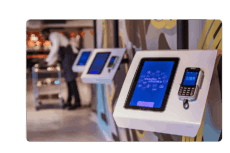
ProDVX today announced full certification of BrightSign’s XC2055 and XC4055 media players across the complete range of ProDVX interactive touch displays. This certification ensures customers benefit from a proven combination of high-performance hardware designed for demanding digital signage environments.
Seamless Compatibility
BrightSign’s XC players, powered by BrightSignOS™, are purpose-built for digital signage and integrate effortlessly with ProDVX displays. Together, the solutions connect to BrightSign’s global network of CMS partners, delivering flexibility and freedom of choice for any signage project.
Power of the XC Players
The BrightSign XC5 line is the ultimate PC alternative, built to deliver breathtaking experiences across DVLEDs, video walls, and other immersive installations. Featuring 8K video, advanced 3D motion graphics, and multiple HDMI outputs, the Intel-based XC5 players deliver unmatched performance, scalability, and vivid visuals across one or multiple screens.
Benefits for Customers
For Integrators & Resellers
For End Users
To support these new workplace models, digital workplace tools and building technologies are helping organisations gain a clearer understanding of how their offices are used. As more systems become connected, organisations can begin to see patterns in how people move through and interact with workplace spaces.
These insights provide a more accurate picture of how the office functions day to day. Organisations can identify which spaces are most valuable, when demand peaks and where resources may be underused. This helps organisations make more informed decisions about workplace layouts, capacity and future workplace investment.
Rather than relying on assumptions about how the workplace should operate, organisations can respond to real patterns of behaviour. In this way, workplaces can evolve alongside the needs of the workforce rather than remaining static environments that only change occasionally.
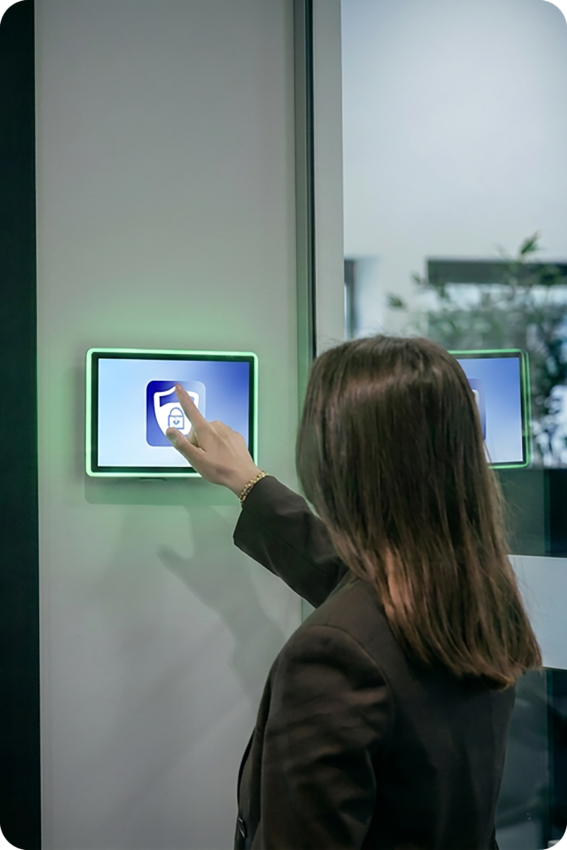
AOSP-based devices (such as the APPC-10S series)
Now, if you're using an AOSP-based device, like the APPC-10S series, the update process works a little differently. Devices that are part of our main product line, will receive firmware updates twice per year. These updates include features, security patches and major bug fixes to name a few.
Older Android versions under ProSECURE will receive firmware updates at the start of the year, that include security patches, patches for major bugs and system certificates. Those firmware releases don't just contain security patches. They can also include bug fixes, performance improvements, new functionalities and other enhancements.
The deployment process itself is actually very similar to EDLA devices. You can distribute updates using your MDM solution and even automate deployment within your environment if that's how you've configured your device management platform. The difference is that you need to keep track of when new firmware becomes available and determine whether it's appropriate for the environment of the customer before rolling it out.
This is exactly where a management solution like ProMGR, or another third-party MDM platform, can make a real difference. Instead of updating devices one by one, you can manage your entire fleet from a central platform. With an optional subscription, firmware updates can also be deployed remotely across all devices, significantly reducing both the time and effort required to keep your deployment up to date.
Devices in professional environments run for years. And that creates a gap that is easy to overlook: what happens to security when manufacturer support stops?
As we explained in our previous blog, Google security support ends at a fixed point. Once it does, newly discovered vulnerabilities go unpatched. ProSECURE fills that gap by extending security support by three years beyond Google's official security support. Your devices keep receiving updates, so you always know where you stand.
For anyone responsible for a hardware budget, this also means devices that stay secure for longer do not need to be replaced prematurely. That protects your investment and removes a recurring cycle of unnecessary costs.
In consumer use, devices are replaced regularly. In professional environments, that’s often not the case.
Think of:
These systems are expected to run for many years, often without interruption. And here a second reality comes into play: investment protection. These devices are not just tools, they are capital investments. Replacing them earlier than necessary because of software support gaps is not only operationally disruptive, it is also costly.
Continuously replacing hardware simply because security updates expire can quickly become an expensive cycle:
So the real question is not only about security, but also about how to protect the lifespan of your investment.
Public PIN
Sometimes you need users to have limited access without giving them full control over the device. That's exactly where the Public PIN comes in. It allows administrators to give users access to specific functions, such as Wi-Fi settings, while keeping the rest of the device protected.
For example, someone can connect the device to a different wireless network without being able to change other settings or accidentally disrupt the deployment. Like kiosk mode, Public PIN is a ProMGR.
Verified Boot and firmware integrity
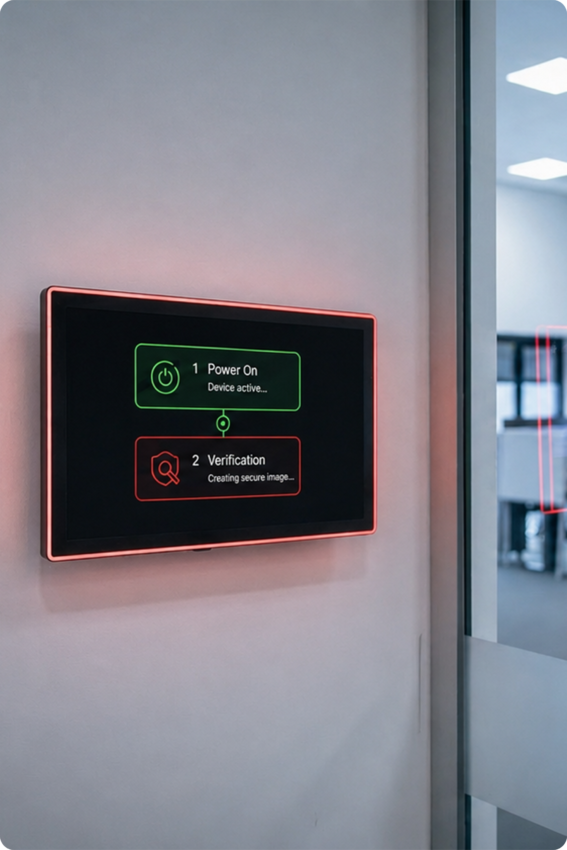
Security doesn't start once Android has loaded. It actually starts before the operating system even boots. Every new ProDVX device ships with the latest available firmware, and all devices running A26 firmware or newer support Android Verified Boot. Every time the device starts, it automatically verifies that the operating system hasn't been modified or tampered with before Android is allowed to load.
On top of that, ProDVX devices only accept officially signed firmware. That means unauthorised or modified firmware simply cannot be installed, providing another important layer of protection against malware and firmware manipulation. This also helps protect customer data. For example, if someone attempted to install malicious firmware designed to steal sensitive information, the device would refuse to boot. The only way to recover the device would be to completely erase it first, ensuring that any personal or business data remains protected.
ProDVX API
For customers who want to build their own management or security layer or manage it more dynamically, there's another option.
The ProDVX API provides secure access to selected system functions, allowing developers to create their own integrated and manageable security solutions that fit their specific deployment requirements. For more technical information, see the A26 Firmware Whitepaper.
Supporting compliance with the EU Radio Equipment Directive (RED)
For organisations operating in regulated industries, all of these security measures also help support compliance with the EU Radio Equipment Directive (RED).
As cybersecurity requirements become an increasingly important part of procurement processes, having devices that are designed with these security requirements in mind can make compliance discussions much easier.
One thing I always tell customers is that effective device security isn't about a single feature. It's about combining multiple layers that work together. Automatic updates, long-term security support, centralised device management, user restrictions, firmware protection, secure boot, API integrations and regulatory compliance all contribute to a stronger overall security strategy.
When those layers work together, you stay in control of your deployment. Your devices do exactly what they're intended to do, and nothing more. Ultimately, that's what most organisations are looking for: secure, reliable devices that continue to perform throughout their entire lifecycle.

Let us know!